This is where the past and the present meet with a lesson in perseverance.
Traveling along Highway 92 in eastern Keokuk County, one’s gaze is drawn southerly to the landmark of the stately spire of Ss. Peter and Paul Catholic Church in Clear Creek Township. It commands a view of the rural countryside, amid fields of corn and beans, a narrow stream called Clear Creek, scenic timberland, and curving hilly gravel roads leading in from two directions. The cornerstone reads June 8, 1898, but the history of this impressive edifice goes back much further and continues being recorded to this day. Many stories and memories have been passed along through generations, of life in those earliest years.
Imagine our immigrant ancestors arriving from a politically disturbed Germany in the early 1850’s to the “promised land” in Keokuk County, Iowa, United States of America. Traveling by boat to Burlington, then by team and wagons to a raw section of Iowa, these ill equipped pioneers forged their way. They took turns riding and walking over poor and often unplatted roads, through prairies and timberland without bridges to ford the streams and rivers. Towns were slowly being populated along these trails. Dublin, Talleyrand, and New Baden were a few of these. In later years the cities of Sigourney, Washington, Richland and Keota were established. The older cities of Dublin and Talleyrand began to die out with the advent of the railway system connecting these other towns.
Every year new settlers would move in, and they were always welcomed by the people. The men would go together and help them build their log homes. The new settlers were assisted until they raised their own crop. In spite of the hard times in those days, people were sociable, happy and ready to help others.
The history of the church family began in 1858, seven years after the Clear Creek community was settled by German immigrants from the Saar valley. The present day church was built some time later, in 1898 as the size of the church community continued to grow. It seems that the new Clear Creek Parish could not reach an agreement on the naming of a parish patron saint. According to legend, six candles, each dedicated to a worthy saint, were lighted. The winner would be the last candle to burn out. The saints, Peter and Paul, vied for the honor as their candles lingered the longest, finally flickering out together. Thus, the name of Ss Peter and Paul was official. Symbols for Ss Peter and Paul are the inverted cross representing Peter’s martyrdom and the double edged sword, representing Paul’s writings.
The point of this small lesson in history is that there never was a town named Clear Creek at this location, but there was a community there as rich in memories and heritage as any town could ever be. Much of that community revolved around the site known as Ss Peter and Paul Catholic Church of Clear Creek twp.
If you have never visited this grand old church let me take a moment to enlighten you.
An architect from Illinois drew the plans, and the contractor was Henry Schroeder of Washington. Foundation stone was quarried from a nearby field and the brick clay pit was located south of the building site. Bricks were made on the site by a company from Muscatine. Only the necessary number of bricks were made from the clay pits behind the church and after the brickmakers left, it was discovered there were not enough bricks. New bricks were purchased to complete the project and these were not a perfect match. Today a close observer can detect the slight difference in the texture and color of the bricks on the upper portion of the church. Over 250,000 brick were manufactured.
Lathing the building was completed at a cost of 2 ½ cents per yard or approximately $2.50-$3.00 a day. The task required a couple of weeks to complete. The contract price of the church was $5850 which did not include bricks, lumber, frescoes, and furnishings. Total estimated cost was $10,000. The building includes a 150 foot spire making it the tallest structure in Keokuk County at the time. The stained glass windows of which there are 14, are truly works of art. The windows were purchased through donations from various families in the community and each depicts a Saint with the family or individual donator’s named inscribed below.
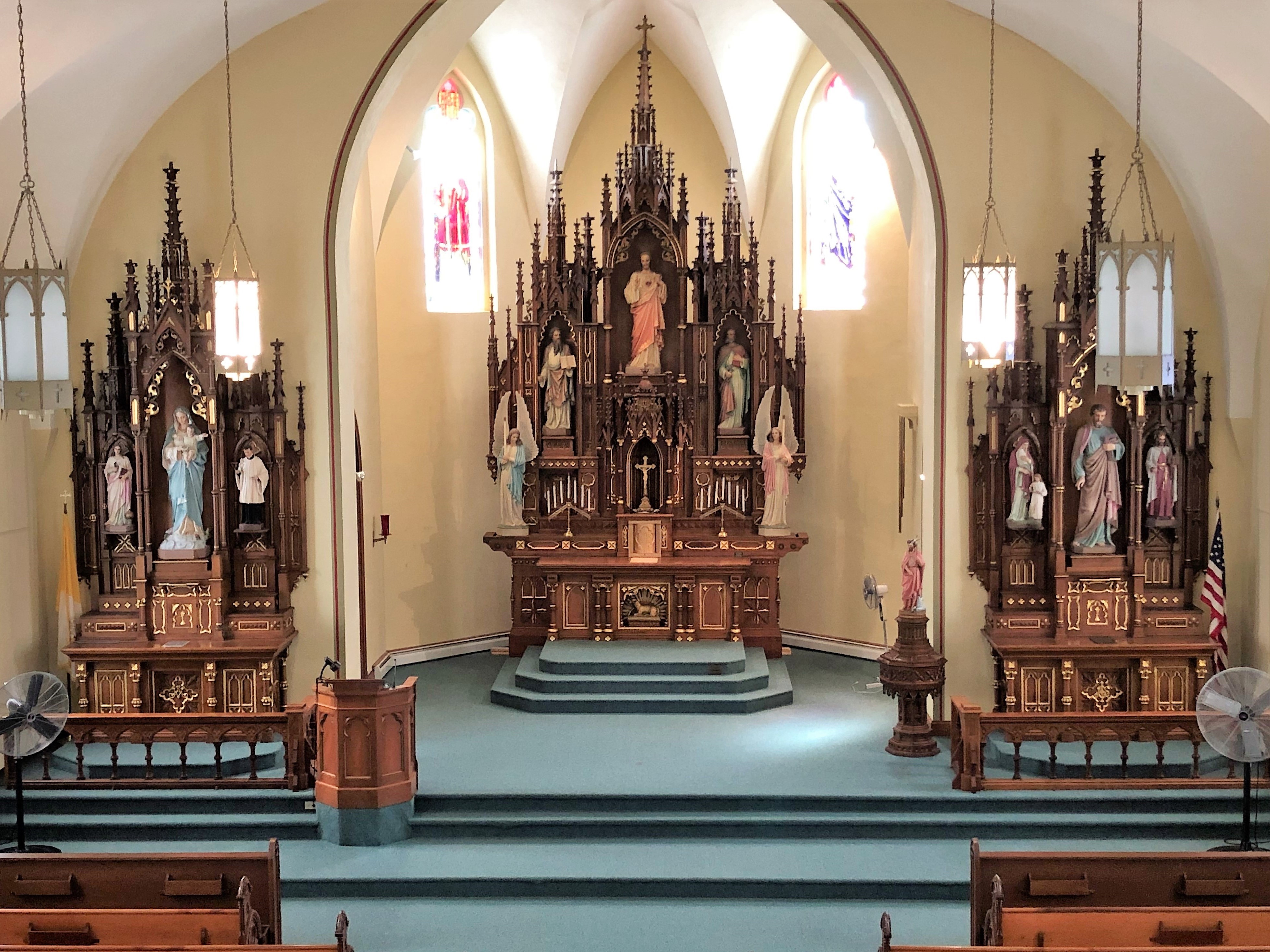
The altar pieces are hand carved of walnut with gold leaf applied in the trim. The intricate carving on these pieces is attributed to Nickolas Juhl of Davenport. They are unsigned pieces which was typical of much of Mr. Juhl’s work.
Of interesting note, the church pews are numbered with brass plates. This was accomplished so that pew rent could be collected from each family that reserved their kneeling space. All parishioners knew where their space was and one did not dare kneel in another’s rented pew.
Let’s take a slow walking tour of the interior of the majestic jewel on the prairie built in 1898-99, namely Ss Peter and Paul Catholic Church. We enter through heavy double doors set in a Gothic arch that encloses a lovely blue and green stained glass circular window with the names of Ss Peter and Paul. The vestibule is guarded by two statuary angels on bended knee, hands folded, residing in the alcoves of the stained glass windows. As we proceed through two swinging doors, the height of the tall main altar and two side altars reaching toward the dome of the edifice command our attention. The sanctuary is highlighted from above by two brilliant stained glass windows spilling colors across the altars. The altars are adorned with many statuaries of saints who were popular in the early years. I could go into an eloquent history of stain glass at this point, but rather I will suffice to say, they are works of art that can only truly be appreciated in person with the human eye.
The “pastor’s bench, formally known as a sedilia, was made open-backed so priests and deacons would not sit uncomfortably on the heavy vestments they wore. This also was a donated gift of a local family who helped build the church by taking wagons and horses to Richland to pick up building supplies. This was over roads that were muddy or cloddy depending on the weather.
The location included a schoolhouse for the children of the local families.
In 1906, a larger and more convenient living quarters for the teaching nuns was incorporated in the building plans for a new school. An interesting feature of this school building was an arrangement for boarding students. Some families would leave their children after mass on Sunday and pick them up on Friday after school. The nuns served not only as teachers, but day and night care providers in every sense of the word. Many times, they were hard pressed for sleeping accommodations and one of the priest’s historical sketches of 1958 states the children would sleep three to a bed…crossways.
In the fall of 1983, sadly, the unused school was torn down due to disrepair.
In 1907, in preparation for the parish golden jubilee, two of the three bells in the steeple were purchased. The larger bell weighing 2060 pounds cost $566, and the smaller bell of 1100 pounds cost $290. These were also by way of donations of area families. Legend has it the bells are named Peter and Paul. Their solemn toll for many years called farmers from their fields for mass, funerals, weddings, devotions and were a signal for times of prayer. Over the years many a generation of youthful lads and sometimes lasses vied for the honor of scurrying up the tower stairs to pull the old bell ropes as the faithful gathered below.
In 1916 Campbell furnaces were installed in the church, but it wasn’t until 1928 that the church was wired for electric lighting.
In 1956 the church was named as one of five outstanding rural churches in Iowa by the Christian Rural Institute extension service of Iowa State College.
Between 1956-1958 the church went through a renovation process. Old plaster was removed and relathing was done by the men of the parish. The woodwork was refinished by the women. The roof was repaired, new cement walks installed, painting completed and a cross on the steeple was replaced. In 1958 funds were raised to tuckpoint the exterior and repair a stained glass window at a cost of $10243.00.
In 1963 the parish hall was renovated and in 1967 the stained glass windows were releaded and sealed with protective storm windows.
Ss Peter and Paul Roman Catholic Church was officially listed in the National Register of Historic Places effective August 6, 1986. Application for this was written by W.C. Page, Historian of Richland, Iowa.
A brick monument was designed and built by a local brick layer with money raised by selling $1.00 chances on four hand sewn quilts created by parish ladies. The monument cornerstone is dated June 13, 1991 and the old school cornerstone dated 1906 is incorporated in this monument.
Ss Peter & Paul Roman Catholic Church officially closed its’ doors in November 2006.
There are a myriad of stories, legends, and traditions handed down from generation to generation that have root in the venerable old church and the surrounding communities of people. Can we so easily dismiss so many lifetimes of toil and tradition, by simply locking a door and walking away?
This historic building was scheduled for demolition in the past year, but a group of concerned parishioners and citizens have recognized the historical value of such a piece of art. The group created a non-profit association with the hopes of purchasing the building, repairing some of the damages that have appeared over the years and opening the building to events. The purchase has been approved and the church will lose its’ Roman Catholic affiliation after 111 yrs. There are many unanswered questions over how all of this will proceed, but with access to skills and personal labor, whether that be by heart, hand, or mind, the determination of the few will bring about the help of many.
The goal of the association is to fund the repairs and upkeep of the structure.
Some of this information is taken from the Clear Creek book “Torrent of Grace” written in 1958, and the updated version written for the 1998 centennial.
Adapted by Barbara Bombei